Friday, November 30, 2012

Second Chances

When I started to teach, I felt like I was nearly the same age as my students.  I didn't understand them and I felt unpopular and uncomfortable.  I went home every night with backaches and sore feet.  People told me to write about my experiences, that I would be grateful later.  People told me the first three years would definitely be awful.  People told me not to smile for the first three months.

I didn't write, or not often.  I did smile, from day one on.  The first three years were hard, no doubt, and it never helped to have someone tell me that was regular.  It took me a long time to learn things - much longer than it had ever taken before.  The gap between my ideas about how things could go and the reality of how things did go was enormous.  I cried in the teachers lounge every week as my colleagues passed in and out.  I feel asleep sitting up on Friday nights around 8pm I was so tired from the week.

In this new job as a coach, there are more parallels to teaching than I can describe, but the many connections between this work and my work as a teacher don't change the fact that I'm in my first year of this job.  It's brutal just like teaching was.  I get yelled at and scolded; I feel insecure and even though I was a teacher just a few months ago, much of the time I don't understand the teachers I'm working with.  

But now, I am writing about it.  I'm getting cut down to size and then I'm learning things fast, practicing being compassionate with myself as I inexpertly move towards understanding.  I still cry, but its with impatience instead of despair, because I know I can do this.

I'm getting my sea legs, I can feel them.  It's happening as I remember to set limits.  It's happening as I remember to be curious about what my teachers are feeling.  It's happening as I feel generally, fundamentally acceptable even when everyone I work with complains about what we're doing.

My compassion for my teachers and my self-acceptance are going hand in hand this time around.  My writing is calling forth my vision and my resilience.  I don't know what I'm doing all the time but I know I will.  I have faith now, and a meditation practice to lean into.  Plus I'm 32 instead of 25 and I have just enough perspective to know that when it comes down to crying on the job, it's really not all that serious.

Thank goodness for learning, for learning faster, for learning harder.  For love and friendship and perspective.  For dancing.  For vegan, gluten free chocolate chip cookies and pumpkin pie.  For you and you and you.

If you haven't entered the enchanted forest and found your power animal, do it now.  It'll save your Friday.  Somehow I think this is an important note to end on.

Wednesday, November 21, 2012

Inquiry with a capital "I"

A huge part of my new job as a coach is to facilitate weekly inquiry team meetings with the algebra teachers I'm coaching.  In some schools these teams are made up of just algebra teachers, because there are so many, and in other schools they are made up of a combination of algebra teachers and other math teachers who aren't teaching algebra.

When I started this job, I had never heard of capital "I" Inquiry, despite the fact that it's been a citywide mandate for a few years.  It seemed pretty simple: look at student work and make instructional decisions based on it.  We were told that teacher teams might be resistant because they'd been made to do some less useful version of Inquiry by their schools to meet the city mandate, or because the teachers who didn't teach algebra would push back on looking at work of students who weren't their own.

In my actual experience, it's just been hard to get down to the business of doing it.  My teams have been legitimately baffled by other parts of the program and we've spent a lot of time just problem solving, delving more deeply into the work of planning on the unit and lesson levels and just using our time together to get more familiar with the performance tasks and formative assessment lessons we're using.  There have been so many things we're doing for the first time that our Inquiry work has just been put on the side.

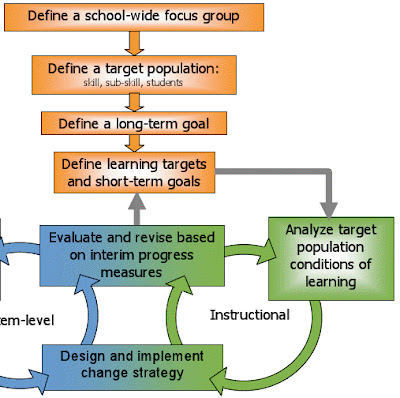
My boss insisted that this week, I start an inquiry cycle with my team.  Here's what this looks like, according to the Inquiry Team Handbook, p.13
We start in the orange part of this diagram to set up our stage.  In our case, the team is already defined as the school wide focus group, and the long term goals are already defined by the Common Core Mathematical Practice Standards.  This week, the team defined it's target population.  Each of the four teachers selected two students, who (based on student work which they shared with the team) are on the cusp of success: students who are just below passing, but who have good attendance and are making an effort.

Over the course of the next four weeks, the team will define a concrete and measurable short term goal for the target population to reach before Christmas break and then begin the green cycle, strategically intervening based on the evidence of student misunderstandings, using student work to assess the success of those interventions, and re-engaging each week to close the gap between the target population and the short term goal.

In the new year, we will start a new green cycle, either re-iterating around the same short term goal if we haven't been successful, or coming up with a new one.

The big idea here is that by focusing on the needs of just a couple of students that are just outside the sphere of success, teachers will better meet the needs of all their students.  I have to be honest: I have not done this before, so I haven't seen it work, but I'm very curious.  What I know is that looking at student work is remarkably rare.  Teachers make statements all the time about what their students are and are not capable of and get optimistic or discouraged about what's coming based on experience (essential, useful, relevant) but not on concrete evidence.  Teachers know many things about their students, but if they aren't looking at student work to determine whether or not students have learned something new between when they entered the classroom and when they left it, they are missing out on something essential and the students are suffering because of it.

I am encouraged by what this process is already drawing out of my teachers.  It's hard for them to bring in student work.  It's hard for them to identify or articulate what the mathematics is that their students can or can't do.  It's hard for them to be willing to break down the overwhelming task of teaching 100 students all of algebra, and instead articulate one goal that they will get two students to accomplish in 4 weeks.  But I am excited to see what happens: even if we fail miserably, even if our interventions are vague and our evidence is muddy and our results seem bleak - I think this is the process through which we will learn how to study student learning and productively respond to improve it.

The inquiry process with my teacher teams is working its way backwards and holding me more accountable in my parallel work with them as a coach.  Having done just this small bit this week with my teachers, I have finally realized that I need to do the same thing as a coach: articulate my short term goals for each teacher and use evidence to inform my decision making about what to focus on with them and how to best support them in growing as teachers.

Pep talk, anyone?
Happy Thanksgiving!

Saturday, November 17, 2012

Learning to Coach

I like sharing what I learn. It's something I think I've developed enthusiasm for as a teacher. I notice it in a lot of different domains - contact improv, meditation, group dynamics and really anything in the realm of the meta cognitive. It helps me to articulate my ideas. I get excited - it really feels like they mean something. At the same time, while I appreciate the enthusiasm I bring to conversation, sometimes I may not listen very well, and as a new coach I think I have been vulnerable to a certain insensitivity to the impact my thinking expression has on others.

Tuesday I practiced applying a new idea: as a coach I've been struggling I figure out what I'm supposed to say to the teachers I've been talking to. I have these questions I base my conversations around, with varying degrees of formality, but I haven't felt very comfortable knowing what to say when teachers respond. I realized last night that I probably was like this with kids and math a handful of years ago. It's simply experience that's helped me understand what a next good question can be. So I came to work today with a readiness to explicitly practice extending that comfort into this new domain. Here's what I experienced:

I would never expect a kid who was uncomfortable with their two times tables to be able to solve equations with fractional coefficients easily. I would never blindly assume that a 9th grader was familiar and fluent with the concept of equality or ratio and proportion. I would prioritize getting the kid to articulate what they were thinking, ask them lots of questions, enjoy what they were saying, listen for the patterns that they themselves might not know they were finding, and celebrate the moments when they were doing something hard and not giving up, making sense of something on their own terms, learning in any context. I would praise them for deep thinking even if they were wrong in their conclusions and challenge them to the next edge of their thinking before saying goodbye.
So I did that today with my teachers. I trust that they are thinking and working hard to make sense of the magnificent mess of a problem that teaching is. I looked for evidence of their decision making and reasoning. As I'm writing this I'm reflecting on how much perseverance I'm seeing in these teachers as they problem solve and how powerful that is since they are responsible for teaching that practice to students. All in all it was a good day. I was looking and so I saw things! I was curious and so I discovered things. I was organized and so I remembered things.

AND

I have learned how to do this and a whole lot more that no one held my hand and taught me. I was nervous and unprepared when I started working with teachers - hoping against hope that my boss would tell me what to do or that I could just copy what my coworkers did. It didn't happen. I figured a lot out anyway. Reading helps. Talking helps. Supervision helps. Writing helps. Time spent mercifully readying myself to learn new things, to be imperfect and learn from it, to feel my growth edge, though I may want to be so much further along, and pushing myself that way, that way, inch by inch moving, developing, expanding...that helps too.

All of that means something important about all of you and all of those that you teach and work with. I'm not conclusive about the meaning - maybe its that we don't need as much help as we think, or that our students don't either; maybe it's that we can relax a little more as we learn and just dig into the learning; maybe it's that things take time to figure out, and there's nothing wrong with that. I'm still working that edge.
During a long chat later that night with my old colleague and dear friend Bobby, I got to practice listening and also got to articulate a bunch of new ideas. (Thank you, Bobby!) One of the big takeaways was this: things are funky all over the place. If there's a problem you can be sure your classroom, your school, your student, your teaching, etc is not alone. You, it and they come by it honestly. Do the best you can and move on.

Live each moment like the world is full of possibilities and you're just about to take them on. Live on that edge all the time. Be fearless and merciful, curious and persistent. There's urgency and there's also the necessity for rest. I hope you all get it this weekend and over the holiday.

Thanksgiving, here we come!

Thursday, November 8, 2012

Ragged, dogged blogging

I want so much to be blogging, to get your insight, to have the excuse to think through my own.  Nearly every night I think about it and it's the thing that doesn't have to be done on a huge list of things that do.  Or so I thought.  This week, I got knocked into such a high intensity experience of isolation in my work, that I have decided to prioritize being here.  I think it may be more important that I write with curiosity and passion about the things that I'm thinking about than to complete my checklist for work every day.  Here's what's on my mind:

1- As coaches, I have wondered if it’s our job to be supportive and curious and resourceful and positive, and at the same time be like advertising execs and the stereotypical brilliant wives of important men: secretly influential, so that teachers feel the ownership of their own ideas (truly) and we aren’t being overly dogmatic or pushy, but still getting the ideas out there.  This feels harder for me than teaching by a factor of at least 6.

2- Back in the summer, I was reading one of the UbD books and was intrigued by their use of GPA as a metaphor for planning backwards: that you must know where you're going to plan a route to get there.  In my experience, this is of course a very useful idea, but it was noticeable to me that no where in the book was there any mention of a starting point.  Using rich diagnostic materials and knowing what to look for in student work on those tasks is challenging, and using the information that comes out of those diagnostics can feel like realizing that you're trying to get from Brazil to NYC barefoot.  But I can't help but believe that this is an essential component of teaching, as it's only by knowing where we begin that the pathway to any end can be direct and useful.

3- Students all want to learn.  Teachers all want their students to learn.  Coaches all want their teachers to successfully work with kids so that they learn.  We are seriously in it together, and often our actions don't match these truths.  Damn.

4- You know that feeling that you get when you're about to do something big: take a trip, move in with someone, start a new job...For me, it feels like the whole world is opening and all sorts of possibilities that normally feel outside my regular realm of experience are all available to me.  I am capable of so much and I can't wait to experience what's coming.  I want to live on this edge all the time.  I want to live each moment like the world is full of possibilities and I'm about to take them all on.  Enthusiastic, strong, ready.

5- Sometimes it's important to just buckle down and spend way more time than I'd like doing work to prepare for what's coming.  I'll feel better being prepared, and it's just a true thing that education takes time to do well, or at least to learn how to do well.  Sometimes it's also important to just be present to whatever is happening, to enjoy it or feel it's discomfort, but to resist the temptation to distract myself with work and to practice radical self-acceptance.  Then it's cool to do both at the same time.

Sending you all abundance in every realm, acknowledgment for the incredible work that you do, no matter how imperfect, because this work that we do is impossibly hard, completely worthwhile and you're the only ones doing it.  Thank goodness.

Recent Ed Reading

With the renewed enthusiasm and clarity about math education that has come with my new position, I have returned to reading about education!  Here are the things I've been reading, some of which I'm still in the midst of...

The Power of Teacher Teams, Vivian Troen and Katherine C. Boles
I found out about this book because New Visions gave a copy to all our principals.  I am finding it a useful and compelling read about the shift schools and teachers are making, and often need to make, in order to improve education.  So far my favorite parts have been learning why teacher teams don't always work and what to do to change that.  I feel like these women are experts and are bringing their vast experience to the table.  Really powerful if you're working on teams, facilitating teams, think that you school should have teacher teams, or just generally are interested in improving how teachers in your school think about teaching and thus improve teaching.  (Ch 3 linked)

The Power of Protocols, Joseph McDonald, Nancy Mohr, Alan Dichter, Elizabeth McDonald
Great resource for understanding the importance of protocols and a good starting toolbox of protocols and how they should be facilitated.  This is a great companion to The Power of Teacher Teams because it offers support for some of the concrete tools required to work effectively with teacher teams.

Embedded Formative Assessment, Dylan Wiliam
As referenced in this blog already, this text is one of the driving forces behind the project that I'm working on for New Visions.  I'm currently reading the chapter that's full of startling statistics about all the various educational reforms that have had literally zero measurable impact over the last 50 years or so.  Yikes!  He's advocating for some very concrete change around the way we look at student work and it's riveting to read his articulate and passionate words.  Highly recommend this one.

Advancing Formative Assessment in Every Classroom, Connie Moss and Susan Brookhart
A nice book to alternate with the Dylan Wiliam book, this is (so far) much more concrete and written for the classroom.  On it's own, I wouldn't read this one, but together they make a nice recipe for making sense of Formative Assessment.

The Hidden Lives of Learners, Graham Nutall
I just started reading this yesterday, but I'm excited.  The author is a serious thinker and unapologetic about articulating his understanding about teaching and learning.  He's committed to lifting the veil and in the first 20 pages (starting with the preface) presents some very compelling perspectives on teaching, and the common misunderstandings around how to do it.

The Math Wars, Alan Schoenfeld
A summary of the history of the Math Wars by one of the guys who should know.  Great history! (article linked)

The Schoolmaster, Dana Goldstein
A portrait of David Coleman, the mind behind the common core.  Very illuminating.  (article linked)

Friday, September 28, 2012

Dylan Wiliam

According to Dylan Wiliam, schools are missing the mark all over the world, and it's clear that teacher quality is the determining factor in student achievement.  After about 18 pages of that, he says, "Evidence suggests that paying teachers bonuses for the achievement of their students does not raise test scores...[Many economists] assume that people are motivated primarily by economic rewards and so offering cash incentives for people to try harder must surely increase results.  They forget that such incentives work only when people are not trying as hard as they can...The vast majority of teachers are trying everything they can to increase their students' achievement.  There is certainly no evidence that there are teachers who are holding onto a secret proven method for teaching fractions until someone pays them more money."

p.18-19, Dylan Wiliam, Embedded Formative Assessment

That mystery pretty much sums up what I've been thinking about this week.

Thursday, September 27, 2012

Coaching Teachers

When I worked at my high school, I got made fun of for so frequently arriving to school with some new idea, enthusiasm, clarity or vision that was going to "change everything."  People imitated me and found my earnestness charming but unbelievable.  They were right to think so at that time - I was rarely able to apply anything I was so inspired by in any sustainable way.

In my new role as a Mathematics Instructional Specialist with New Visions for Public Schools, I see even more clearly that it is far easier to think about mathematics education, opine and discuss and argue, than to actually enact any measurable reform in a classroom.  Easier said than done pretty much sums it up.

At the same time, I have the support now, and I am the support now, that can turn inspiration into action, ideas into realities and old paradigms into new.  My hope is restored, and I treasure the shifts in my consciousness as they happen.

Tuesday I spent the day at a school where three of the four math teachers are new to the school, one is entirely new to teaching and one is new to teaching in NYC public schools, having taught for two years in Africa as a part of Peace Corps.  The fourth is the sole survivor of her former math department, and while she's familiar with the school and the kids she has a completely new department to support and be supported by.  In addition to the large adjustments all of these teachers are making this year, they have signed on (or been signed on by their principal) to be a part of the awesome project which the reason I'm there in the first place.

Our project, a2i (Accessing Algebra Through Inquiry) is bringing performance tasks, formative assessment and Inquiry (looking at student work to make instructional decisions) to the common core aligned unit.  We are providing a lot of support but we're also asking a lot in the name of student learning that they wouldn't be doing otherwise and they've been overwhelmed just orienting to everything entailed in their new jobs.  Every day I spend with them, they tell me how hard their work is, how much they are expected to do, trying to do, and I hear how unreasonable it is, how truly impossible the job of teaching is.  I see them doing their best, and I know they truly are doing their best with the understanding and resources they have available to them.  I also know that they are capable of far more than they think, far more than they know, and that as they learn and expand their thinking they will realize this potential.

This is why I blogged about two simultaneous truths the other day.  As I watch my teachers teach, I see both realities at the same time: the one in front of me, which is underplanned and overburdened, undersupported and oversimplified, and in which they are nevertheless (I am certain!) working hard and doing their best.  I also see that they could and should plan more, ask for (my) help, and do far more for kids than they are currently.  It's not like they have to teach for another ten years to be better.  They can be better tomorrow.  It might take an hour of planning.  It might take letting go of some idea they have about themselves as teachers or about education in general.

Again, it's easy for me to say as the observing outsider.  I know how imperfect my classroom was.    So how can I get high and mighty just by stepping towards the back of the classroom?  The two truths keep me humble and honest about what I'm seeing.

Teachers are pattern-making-machines just like kids.  They are making connections, doing what they're doing for reasons, and it's important to value where they're coming from and what they're thinking.  Teacher misconceptions come from observing unintended patterns or patterns that were perpetuated by their exemplars who also had misconceptions.  Teachers need to be given experiences in their professional development where the patterns they see assist them in making conclusions that drives their work to be more efficient and effective.  They need to be inspired, as I was, by the patterns they are finding, and then they need to be supported with scaffolding and structure and routine that helps them transfer that understanding into their own classrooms.  Transferring theory into classroom practice is a skill to be taught and developed.

All too often we educators assume that adults don't need the kind of structure that kids do.  Every teacher I know has experienced the irony of the two hour lectures in ed school about how people learn: better in groups and changing points of focus every 10 minutes or so.  When we're learning, adults need the same things that kids do.

So I'm learning as a coach to take my teachers under my wing; it doesn't matter what they don't know when they come to me, it doesn't matter why they didn't learn it before - it has become my task, my charge, to coach them.

On a juicy side note, the team of coaches that I'm working with is amazing, and through them I am learning so much about mathematics education, about coaching, about learning, about reflecting.  Our diversity as a group is always bringing out the perfect balance of multiple perspectives on things that helps us meet our teachers where they are and support them in making the next step.  Through their eyes I am learning better what best my service is and learning to see myself with the appreciation others have for me.  In turn, I see my sincere appreciation of my colleagues permeating them more and more fully.  We tell each other what we do well and it really sinks in.  Then all the stuff we need to do better just feels like a ripe and nourishing challenge.  THANK YOU.

I hope this finds you all appreciating yourselves and your work, which is big and hard and worthy and honorable in whatever manifestation it's taking, as you continue to push your own growth edges.  I hope you are compassionate with yourself as you strive to learn, and that your practice with yourself encompasses your students with the same sweet drive to be huge and the acceptance of wherever they are right now.

Happy almost Friday.

Tuesday, September 25, 2012

Simultaneous Truths

It turns out, I believe, that two things are true at the same time:
1) Everyone is doing their best with the understanding that they have available to them.
2) Everyone is capable of far more than they realize, most if not all of the time. 

Thursday, August 2, 2012

My new job and an insight


Last Friday night I had the pleasure of talking about my new job with friends over Ethiopian food in Brooklyn. I am now a Mathematics Instructional Specialist with New Visions for Public Schools, currently in the process of wrapping my head around the many departments and projects that will influence my work in the next months.

So far my job mostly looks like me and my four colleagues discussing, reflecting, debating, often clarifying and sometimes presenting the big ideas we have around our work as coaches for math teachers in the Bronx. This is extremely fun and so far I really love this job – something I’ve never said before! When September rolls around my time will be spent traveling to six different schools, supporting the Algebra teachers develop their inquiry practices (looking at student work and making curricular decisions based on student needs they observe in the student work) and use performance tasks (sophisticated and rich problem solving activities) as their diagnostics, formative and summative assessments. For all of you math educators, there’s a whole lot more to say about all that, and I plan to return to this blog to say it. But for now, my dinner.

Once I started talking about my job, it took a long time – about 45 seconds – for my friends to begin reminiscing about how bad they were at math and how difficult it was for them in high school, even though they’re smart and had tutors and went to good schools. They commiserated for a few minutes while I experienced a familiar pang of frustration and intolerance that so many people are willing to publicly admit complacency with such a negative relationship to mathematics. I was especially annoyed because just a few hours before I had been disappointed to hear the same basic attitudes expressed at work by our non-math colleagues.

Painful though this moment was, the intensity of my emotion struck a chord in me, and my curiosity was piqued: people that I respect – educators that I admire and friends that I love – must be saying this to me for a reason, and it’s not to annoy me or invalidate my career. I’m humbled to say I think this was the first time I have ever been sincerely curious about the pervasiveness of this attitude in my adult communities. I have come to expect it to some extent in adolescents, who are developmentally designed to resist everything adults present to them, but theoretically ripe for transformation. But up until now I have always dismissed and been frustrated by this attitude in adults.

My friends and colleagues are bright, successful, beautiful and powerful people. I like and respect them each immensely. They are all well educated, capable, self-sufficient, and successful, each with degrees beyond college and multiple artistic talents outside of their careers. They have been highly successful in their work in hospitals, corporate banking, MTV and schools. In addition, I believe that everything I hear has some benefit: maybe there’s a new idea for me to integrate, or maybe I need to hear an old idea again. I finally wondered – which is it for me? Why is it that people keep saying this to me?

My first thought was that this is our large scale feedback and inspiration for the work we do. We all know that math education in this country needs work, and that’s why we’re all so excited to be doing it. I hope one day that my friends and colleagues will be excited to do math with me, and interested in the actual content of the math I’m teaching. Right now, I’m happy to be just a bit more interested in really listening to people as they tell me their experiences, trusting that there is more for me to learn about just how bad math education has been for people.

A few days ago began the resurgence of another familiar conversation in response to the NYTImes “Is Algebra Necessary?” oped. I feel like the NYTimes publishes an article like this every year or so, and each time we get pissed and feisty, quick to lash out with a slew of offended and defensive responses. For a second time in a week, I felt clear about this old dynamic: our more global community is simply acknowledging the imperfection of math education that is the reason most of us are math educators in the first place. Why is anyone surprised? Our job isn't to defend ourselves (we're working hard, doing great) but to be curious about what new insights we can gather from their testimonies, which can’t help but illuminate the experience of students in general.

On a side note, my boss Russell West, Jr. has a quotable response to the article which I’ll paraphrase here because it’s so awesome: “We agree with Andrew Hacker and will respond as Daniel Wilingham suggests: must kill school algebra to save school mathematics.”  That’s our internal tagline for the work we’re doing in schools.  Shhh!  It’s a secret.

I have so many revelations and insights and a deep longing to spread the good word about all of them, or at least get them "on paper" here. I hope my use of this real estate will contribute to the enjoyment and satisfaction of its readers.
Great to be back ya’ll.  Happy August!

Friday, September 16, 2011

Yantra in Math Class

Today was our first pop quiz.  If you've read anything here in the last year, you know that means meditation and cookies.  I have been itching to meditate for the last 6 days with these kids, just waiting for an excuse, not feeling quite ready, finally caving and just resting in the structure from last year.

But this year I wanted to be a bit more thoughtful about it.  Here was the lesson...

I.  Writing prompt: What do you know about stress?  They write for about a minute.

II.  Class conversation: Raise your hand if you've ever felt stressed.  Raise your hand if you've felt stressed today.  Raise your hand if you get stressed out about friendships.  About school.  About math class.  What happens when you get stressed, what does it feel like?  What does it look like?  What do people do about it?

III.  Introduce Jesse as a stress-reduction (I didn't actually use the word meditate) instructor: In addition to teaching math, I also teach adults and my students to techniques to manage and reduce their stress so that they can feel better and focus on whatever it is they want to do.  When people get stressed, as you guys described, at best it's uncomfortable and distracting.  Sometimes stress about a test can cause a kind of panic that makes us forget everything we've learned.  So in this class, we'll experiment with some different techniques to help us focus and relax at the same time.

IV.  Pop quiz announcement: We're starting this today because we have a pop quiz, and I want you to experiment with not being stressed about it.

V.  Introduce the yantra: There's a picture of a yantra up on the smartboard.  I explain: in India, people have been making these kinds of geometric images for thousands of years, and using them to relax and concentrate.  Today I'm going to tell you a kind of story about the yantra while you look at it, and you can just see what happens to your body and mind.  There's no pressure, just see what happens.  Keep your eyes open and look at the yantra.  Listen without speaking as I tell you the story...

VI.  The story: The dot in the very center, called the Bindu, represents unity, our connectedness to each other, our families, our neighbors, the whole of the universe.  It's small and hard to see, but see if you can just focus your eyes on that one small point.  (wait time...)  Now let your vision expand so that you can see all the red triangles.  They say that the triangles that point up represent the masculine or male energies in the universe, and the triangles that point down represent the feminine or female energies.  (wait...)  Now look at the circles around those triangles.  These circles symbolize that which is constant, infinite, cyclic in our lives; time, which has no beginning and no end, our breath which pulses in and out, 60,000 times a day without our effort, gravity which pulls on us all the time, the universe which is infinite in it's vastness, always expanding, no starting point, no end point.  (...)  Now look at the petals of the lotus flower around the circles. The lotus flower is so important in India, and in this yantra it represents your understanding, your knowledge, which is opening, always expanding, growing.  (...)  Finally, let your eyes see the squares at the outside of the yantra.  These squares are your identity, your separateness, your individuality, which enclose everything else.  (...)  Look at the Bindu again, that point in the middle.  Relax your eyes, so that you can focus on the Bindu but see the whole yantra at the same time.  (...)  Close your eyes and see the after image on the lids of your eyes.  (...)  Open your eyes and see the yantra again.  (...)  Close your eyes again.  Just see how much of the yantra is still visible to you.

VII.  Debrief: Write for one minute about what you experienced.  What did you feel, what did you notice?

VIII.  Pop quiz:  ...And if you feel stressed, experiment with seeing the yantra in your mind's eye and just see what happens.  See if it helps you relax and focus.  And if it's not quite enough, there will be cookies.

----

It was awesome to do a meditation with kids that doesn't require them to close their eyes.  I hadn't planned this part, but as it turned out it was so much easier to get them to do this practice than any closed eyed meditations I've done in the past.  It was awesome to introduce meditation to kids with such a high voltage geometric image.  They had cool experiences with it.  I want to get them to make their own and put them on their binders so they can remember and keep that intention of focused relaxation, relaxed attention, anytime they're in math class (and beyond!)

2) My incredibly brilliant co-teacher found himself somewhere between lazy and curious, and when it came time to teach his lesson (which we usually share) he began...

"So this isn't really my thing.  This is really Jesse's thing, and she's really crazy.  So it's ok if you think this is weird, because I do, but we'll try it and then we'll decide if we ever want to do it again.  We'll wait to talk about how weird it is til after she's gone."

He did the whole thing.  I happened to walk in when he was introducing the yantra, and he asked me to lead the storytelling part, but he was totally prepared to do it himself.  Amazing.  We are learning so much from each other.  Which I will continue to tell you about...


Thursday, September 8, 2011

first day of year six

Today was the first day, and the two things I want to share are about my new coteacher/department cofacilitator.


1- He regularly counts how often I say awesome.  Or maybe how often I say awesome and amazing.  In meetings and I think maybe in class too.  Then he gives me responsibilities because I'm awesome. 
2- I'm so excited about our curricular collaboration, and want to say right now, whatever comes after, that what we're up to seems to be somewhere between strictly awesome and downright revolutionary.  Always.  


We make a strange and really good team, I think.  I'm curious how it will develop and excited to share our work with you!

Friday, August 26, 2011

Jennifer Abrams on coaching...

In Jennifer Abrams' most recent newsletter, she wrote about a bunch of cool stuff, and I encourage you to read the whole thing here.  In particular, I keep wanting to go back and read this paragraph on dramaturgy and how it connects to coaching.  As I contemplate my new coaching role at school, this gives me language for what I aspire to do, and will help keep my eyes on that vision.

from Jennifer:

Definition of a Dramaturg
This July I spent time at the Kennedy Center participating as a new board member of the National New Play Network as NNPN ran their summer MFA Playwrights’ Workshop. Theater professionals from all over the country came to support six new playwrights as they brought their plays more fully into being.  The playwrights were connected with a director, a dramaturg, other support staff and a cast of actors. After one week of amazing collaboration, we experienced a reading of their work.  Of all of the parts people played during the week, the role that intrigued me most was that of dramaturg. We don't have dramaturgs in the teaching profession or do we?  In a nutshell, a new play dramaturg has three roles. One - to be a champion for the play itself.  Two - to be a brainstorming partner for the playwright.  Three - to be a liaison between the audience and the play.  If done well, the dramaturg is a coach, a muse, a healer, a connector and much more. We who are leaders at any level in our organization or school might consider ourselves as resident dramaturgs - champions of the work we are trying to do, brainstorming partners for our colleagues, and liaisons between our schools and the ‘audiences’ we work with - students, families, communities.

Monday, August 22, 2011

Your appreciation for all things is off the charts...


"Every person whom you come into contact with, every exploration into every place on your planet, every interaction with anyone who comes to you will be one that has the potential of uplifting them because you represent the best of all that exists in all of the universe. And you know it because you feel frisky. You're full of yourself. Your eyes are bright.  Your body feels good. Your body is functioning the way you want it to. Your heart is lifted. Your mind is clear. Your wit is sharp. Your fun is full. Your eagerness is pronounced. Your love is apparent. Your appreciation for all things is off the charts." - Abraham Hicks

off the charts people...let's go...

Thursday, August 4, 2011

Videos of Self Teaching

I was just going through a bunch of unlabeled discs, most of them DVDs with films I made back when I was an experimental filmmaker making films.  I was getting into the routine of recognizing the films, labeling them, throwing them away.

Then all of a sudden there's me, 4 years ago, in clothes and hair and glasses I remember but haven't seen since then, welcoming in a classroom of kids that I taught my first year.  I actually experience not believing what I'm seeing...I have no memory of this being recorded, of this particular day, of those conversations, of that way I'm moving or speaking.  I know those faces, relatively sweeter and younger than I would have thought, utterly familiar.  And there I am, so serious, holding my clipboard, hardly looking up, but when I do serious in that too, connecting with such conviction and intensity.

I see simultaneously the significant and undeniable presence I am in that room, just because I am who I am, despite all my obvious mistakes and inattention to the important stuff, I am there and these kids that I remember being so difficult know me and are comfortable there.  I imagine them seeing me being so serious, keeping track of their failures, so clinically observing their shortcomings.  That's what I recognize there.  It takes me back.  I remember the feelings I had about those kids.  I feel grateful I'm not still living that life, not because it was so hard, though I remember it was, but just because I'm grown and full in new ways now, and am glad for those transformations in me.

I wonder if I could have had any objectivity if I had seen this when it was shot.  I would wish for myself to recognize the fundamental worth of that teacher in the room, and be able to also see how easy it could be to shift the dynamic in that room.  Those kids deserved to be seen, watched, loved through simple attention to their thinking and presence in the room.

I'm humbled and honored to have seen this just before school begins again.  May I learn how to attend to what's important, may I find the balance between humility and sincere confidence and rest there.  I think next year I'll use video (sped up?) more in my coaching.  Immediate insight!

Tuesday, July 19, 2011

A Teacher's Job

Someone must have suggested this idea to me, but I don't know who, when, where it came from.


Let's imagine a new image of teaching:
There are bundles of packaged and organized mathematical concepts, ideas, or units.
It's the teacher’s job to get that bundle unpacked before the students come in, so that they can experience the natural questions and packing and organization that they do themselves.
Rather than simply describing the still packed bundles, or unpacking and repacking them in a powerpoint.

OC...moments from the year

I am taking time today to go through any notes I wrote during the year and incorporate them into my planning for next year.  It's nice to try to do something with my great ideas!  I'm having a good time, enthusiastically diving into work during vacation.  It takes discipline and presence to really do this with joy.

I found some quotes from a student, OC.  I didn't share them before because they felt too sweet to tell anyone else, but now I think there's something to learn here.

"It's like God took everything amazing and put it together (hands gesturing, pulsing towards each other with enthusiasm) when he made you."

"Jesse, when you get married can I come to your wedding?"

"Jesse is way too kind and adorable for anything bad to happen to her."

"Oh, I know that I can't make you unhappy.  Nothing can bring you down, Jesse.  If you'd been around in the 1930s the Great Depression would never have happened."

I really felt connected to OC, like he got it, he got me, he got the math, not just the content but the beauty, the incredible awe of it all.  He is an amazing kid, sophisticated, with remarkable resonant maturity in a 14 year old body.  I was totally professional with him, but there was such tenderness and sweetness in our interactions, it felt like it was too much.  And indeed, by the end of the year he had really pushed me away, doing his adolescent thing beautifully, if painfully for me.  He laughed and scoffed at me, cut my class, apologized but avoided conversation, actual sincere interaction with me at the end.

I took this kid's crush on me personally, and I think that made school harder for him.  In order to find balance, he had to push extra hard against me towards the end of the year, so that it felt like there was nothing between us at all.

At the end of the year this year, I felt really sad, more than ever before.  My aversion to saying goodbye, to stop seeing their faces everyday, was so strong that I didn't want to come to school in the morning.  It was funny too, because they were never more annoying to me than at the end of the year and so being with them was joy and sorrow, annoyance and delight all at the same time.  We were terminating, as they call it in the psychoanalytic approach to group dynamics, and it was painful for all of us, probably more so for them than for me.  I taught 9th and 10th graders last year, so I will see them again in the halls, but it will not be the same.  This is the thing that I know now that I didn't before: they will see me and we will know each other, some will hug me and say hi, others will not, in any case it will not be the same.  I will become obsolete in their experience of high school, just by virtue of being in their past.

That's the way it should be.  It's normal, there's nothing at all wrong with it.  But I felt it this year for the first time, as we were ending.  I felt the finality of the goodbye, the end of seeing them every day, for better and for worse, when we get along and do amazing work and when we are frustrated constantly and accomplish nothing.  I am living a new life now, without them, without their mysterious adolescent energies in my life.  Next year when I return that energy will return to my life but they will not.

This stuff is interesting, right?!  As I experience more of these intense emotions in my relationships with kids, I get better at holding space for them to be where they're at, and to support them throughout their pushing and pulling.  That's what I'm there for.  I think this experience with OC will allow me to better see what's going on with a kid without taking their affection or mistrust personally, and will give them space to grow and learn in the safety of my conscious presence.  I think my awareness of how painful it is to say goodbye will allow me to better appreciate them while we are together, and I trust that my experience of enjoyment and enthusiasm will serve them well.

Thank you OC, and all of you, my previous students...through you I have learned so much.

Sunday, May 22, 2011

Reading and Writing in Mathematics

Also, we've been studying up on Literacy in our school this year, and our librarian just shared this resource with us.  Haven't tried these yet, but they're thought provoking for me as a relative novice in teaching writing and literacy.

CUNY requirements, for all you NY State folks...

Just discovered that these have changed, and thought I'd pass on the heads up.

Saturday, May 21, 2011

The Rapture

The last week has been an intense one: rain every day, anticipating the end of the year and on top of that the world was supposed to end today.

My 10th graders didn't mention it once, but my 9th graders were obsessed.  Everyday discussing with humor and dramatized panic how their lives would end, loudly derailing all attempts at mathematical instruction.  From my point of view it's a reasonable question: I'm not sure I would choose to be in school if in fact we really knew we were living our last few days.

Yesterday was the pinnacle.  RJ came into school and wrote "THE END IS NEAR" on the whiteboard.  I inserted "of school" between "end" and "is," but no one noticed.  Every student was asking me what I believed, but they didn't care about the answer.  Whether they agreed with me, were reassured or skeptical, it didn't change their desire to talk about this and nothing else.

By math class two periods later, they were saying goodbye to each other.  ST asked, "Jesse, will we still have math class in heaven?"  DM shouted out, "Jesse I love you, I'm going to miss you," and then asked the class if they would miss him.  "Clap if you're going to miss me, class."  Everyone clapped.  "Clap if you're going to miss ST."  Everyone clapped.  "Clap if you're going to miss Jesse."  Everyone clapped.  Very sweet.

Then out of the blue, OF loudly shares, smiling, "I'm going to die a virgin."  The class notices but the chatter continues.  I feel like I'm the only one who has really appreciated the vulnerability and generosity of this comment.  He is so sincere, expressing in his innocence the loss of all the unknown ahead of him.  He doesn't sound like he is eager to remedy the gap in the next 24 hours, just that he's sad, or even nostalgic, for a future he won't live to see.  Amazing.

The funny thing is that all week I've been trying to figure out how to terminate with these students.  From all that I have learned about in studying the theory of group dynamics, termination, or the ending of a group, is a hugely important opportunity.  We all re-live our experiences of loss and abandonment when things end.  If the facilitator of a group makes this ending transparent and gives the group time to process their feelings, to experience an end without surprise, the group can both experience less trauma in the ending itself, but also heal their past injuries.  What this looks like in my classroom is simple.  I tell them every day how many days we have left.  I keep bringing the end to mind and then when they have things to say about it, I listen.

This week I learned that with the kids who know already that they have to repeat the year and are disinclined to come to school for academic reasons, the group can still be a reason to come to school.  They are a part of something, whether they pass or fail, whether they behave well or badly and get kicked out of class.  It matters that they are here at the end; it matters that they are a part of this group that is ending.  We all want them there, and it's not the same without them.

So when this major endings conversation arose, I didn't stop it.  This rapture thing is getting my kids to do all this processing around endings and it's awesome.  So "No, we're probably not going to die," I say.  "But this group is going to end in 3.5 weeks."

It helps to have time to say goodbye.  To tell each other that we're going to miss each other, to acknowledge that even when we see each other again next year it won't be the same.  Some people will stay and others will go, and our group will not exist anymore.

Powerhouse.

Monday, May 9, 2011

Resilience, process, curiosity and relationships

One backdrop, two stories, one conclusion.

Backdrop: These four words describe our most important values across our school.  They are the threads that connect the islands of our classrooms, the values that we aspire to teach.  I like them.  I think they are basically the most essential ingredients for a happy life as well, and the fact that we came up with them to align our curricula is compelling.

Story 1: I saw one of my favorite seniors, VC, this morning at the deli.  She looked exhausted and discouraged.  I carelessly told her she was doing great, that it would all be over soon.
And it's true.  She is, and it will.

But as I walked out of the deli, I remembered that it won't stop.  High school will end, sure.  She'll do fine, graduate and all that.  I'm not worried about her.  But the stress and exhaustion and dissatisfaction that she is experiencing, those aren't over when high school ends - at least they weren't for me.  College will begin for her, with all it's responsibility and the challenge of that independence.  Fun, liberating, exciting, stressful, exhausting, the whole gamut.  Graduation, job hunting, career finding and having, family...there's a progression to move through if she wants to, that will just keep going and providing her with opportunities to feel stressed and exhausted or not.

I want her to enjoy this part too.  To enjoy the intensity and excitement and grief and fear and know that she's exhausted because life is so grand, so big and full.  Or if it's too painful to enjoy, at least to feel it fully and know that she is really living.  That her life is already what she makes it, and that she shouldn't wait 7 weeks until graduation to live it fully, or even 5 days.

Story 2: This morning I forgot to check our student teacher GL's worksheets for mathematical hotspots.  We talked a ton about instructions and formatting but I failed to see that her quadratics had integer vertices, and they didn't, and so the kids didn't know how to do it.  It was fine, I told them it was my fault and we'll fix it for tomorrow.  Then I taught GL how to come up with nice systems of quadratics and I'm sure we'll do fine tomorrow.

But GL didn't look so pleased.  She's really hard on herself and felt unsuccessful because of that mistake. No big deal, I know that feeling.  But watching her do that, watching her align her success as a teacher with each individual success in the classroom...it was so obviously not true, beside the point, and most importantly, a total distraction from the actual work of improving our teaching.  There is a reflectiveness that's necessary to grow and learn, but the self-judgment that comes afterwards...that's unnecessary.


Conclusion: Those four words from the top come in: resilience, process, curiosity, relationships.  I want to speak about these words with both of these young women.  To plunge into their deep resilience, not just surviving while they anticipate some future that will be easier but deeply resting in knowledge of their own self-worth, connected to this day, this difficulty as a part of their process in growing and learning, curiosity about how that will unfold and fierce optimism about how awesome it will be.  Because they deserve it, and it will be...may my relationships with both of them support their ever more and more loving relationships to themselves.  May they find ease and enthusiasm in their work and lives now and always, pulsing in and out of their seeming successes and failures with curiosity and acceptance.